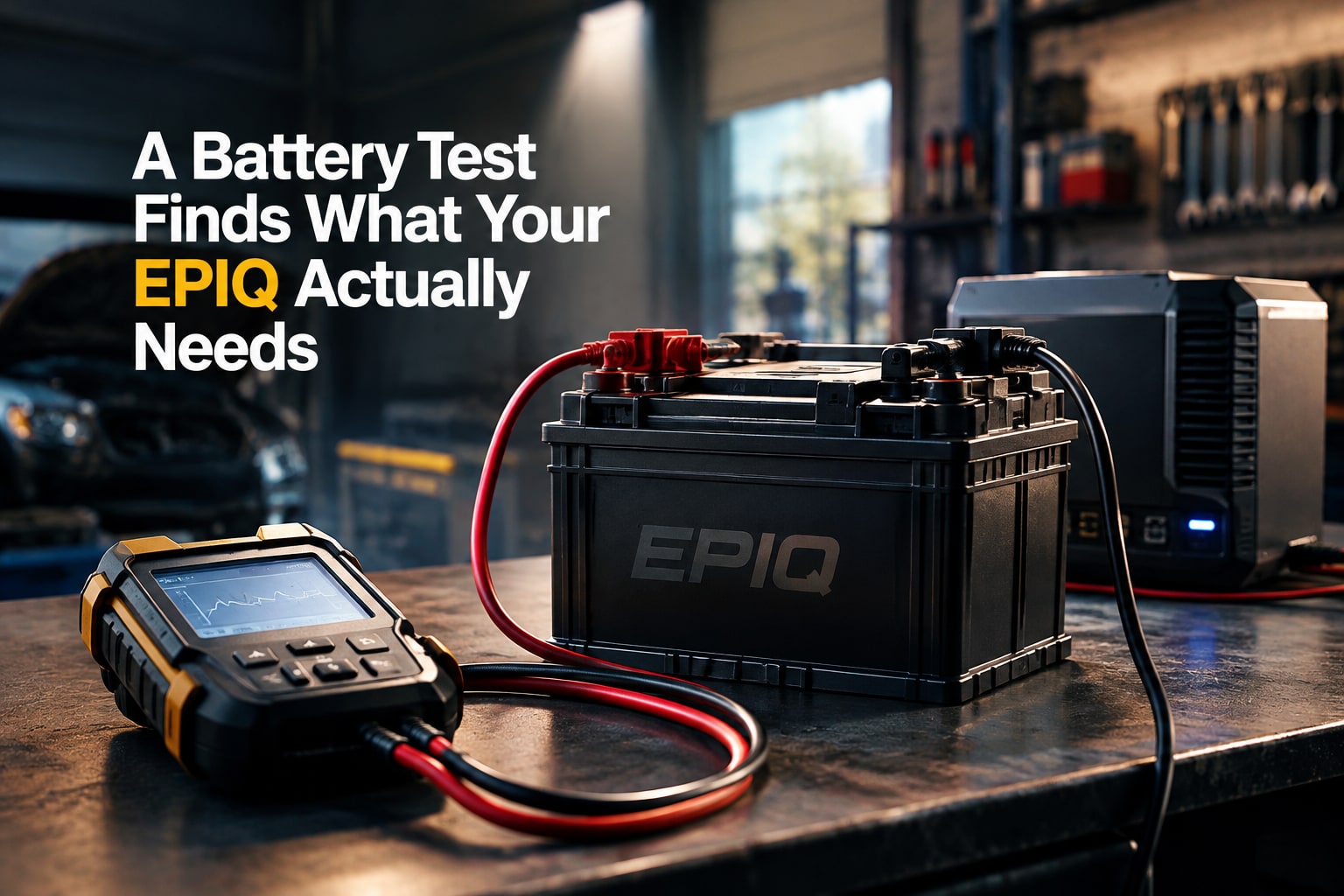
An Exide EPIQ that gives less backup time does not automatically need replacement: the fault could be charging, cabling, inverter load, ventilation or the battery itself. By the end, you will know which checks a competent shop should perform, what fitment and maintenance details matter, and when replacement or manufacturer support is justified.
Key takeaways
- Confirm whether your EPIQ is a stationary inverter battery, not a car starting battery.
- Test battery voltage, charging output and wiring before replacing the battery.
- Match capacity, terminal layout and charging requirements to the complete installation.
- Check the load, inverter and battery bank when backup time falls.
First confirm what kind of EPIQ battery you have
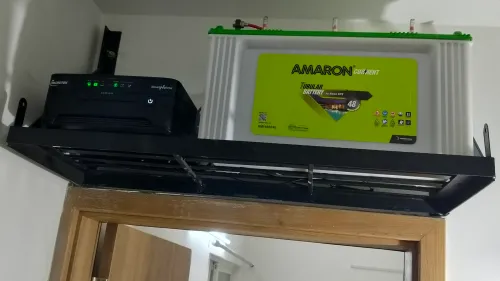
Yes, a car battery shop can diagnose an EPIQ, but only if it understands inverter batteries rather than treating it like a car starting battery. Check the nameplate and manual first: EPIQ is a stationary backup battery for an inverter, not a battery designed to crank an engine.
A shop that handles only automotive starter batteries may sell a replacement but cannot reliably assess backup performance.
Before visiting, ask whether the technician can provide:
- Testing for deep-cycle tubular batteries, including electrolyte inspection where applicable
- Controlled charging and voltage checks for inverter use
- A real inverter-load test rather than only a handheld car-battery test
- Terminal, cable and battery-bank inspection
A quick tester cannot prove how long an EPIQ will run your appliances. The technician should record each battery’s individual voltage after the charging surface charge has dissipated, inspect the case and terminals, and check electrolyte level when the design permits it.
For Exide EPIQ battery support, keep the purchase invoice and ask for a job sheet or test report. It should identify the battery model, serial number, manufacturing date, installation date and recorded readings.
Retail testing and manufacturer warranty approval are separate: warranty eligibility can require an authorised inspection and proof that the battery was installed and charged under the specified conditions.
The right tests separate battery failure from vehicle or wiring faults
A short backup period does not prove the EPIQ battery has failed. Measure the battery, charger, cables and inverter separately, because a loose terminal or excessive inverter load can produce the same symptom.
| Measurement | What it identifies | Warning sign |
|---|---|---|
| Rested voltage at each battery’s terminals | State of charge and imbalance | One unit reads materially lower after charging and rest |
| Charging voltage at the battery | Charger or inverter charging fault | Voltage does not match the EPIQ manual’s specified range |
| Controlled inverter-load test | Usable capacity under real demand | Voltage collapses quickly or runtime is far below expectation |
| Voltage drop across cables and terminals under load | Resistance in wiring, lugs or fuses | Battery voltage is healthy but inverter input voltage falls |
| Inverter output, load watts and standby draw | Excess demand or inverter loss | Load exceeds rating, or the inverter consumes power with appliances off |
| Electrolyte level and hydrometer reading, where applicable | Condition of a flooded tubular battery | Low level or unequal specific-gravity readings |
| Alternator, cranking and parasitic-drain tests | Vehicle charging or overnight-drain faults | Charging is weak, starting is slow, or current remains high after shutdown |
Test each battery separately, not only the bank. A handheld car-battery tester alone cannot establish inverter runtime. Ask any car battery shop Exide EPIQ for help only after confirming it handles tubular batteries, controlled charging and load testing; request recorded readings, serial number and test date.
Match the replacement to the complete installation, not just the brand
A replacement EPIQ must match the complete backup system, not merely carry the Exide name. Read the battery nameplate and manual, then confirm voltage, Ah capacity, physical dimensions, terminal polarity, cable reach and the inverter’s charging profile.
1. Record the existing battery’s model, serial number, manufacturing date and installation date. Keep the purchase invoice and request a job sheet with test readings; Exide EPIQ service and warranty review can depend on these records.
2. For a series or parallel bank, use batteries with the same model, capacity and closely matched age and condition. Mixing a new unit with an old one creates uneven charging; unequal cable lengths in a parallel bank can produce the same problem.
3. Connect positive to positive and negative to negative, then check polarity with a meter before switching on the inverter. Use cables sized for the inverter’s current, secure every terminal, and fit the specified fuse or circuit breaker close to the battery bank.
4. Charge the battery with the manufacturer’s inverter setting, not a car charger’s guess. Keep lead-acid batteries upright in a ventilated area away from flames and sparks because charging releases hydrogen.
5. During maintenance, inspect terminals for corrosion, check electrolyte level only on a serviceable flooded battery, and add distilled water without overfilling. Do not perform equalisation unless the manual permits it.
After installation, record the inverter settings, charging voltage, battery-bank configuration and load-test result. That documentation exposes a wiring or setup mistake before it damages the replacement.
Low backup time can come from the load, inverter or battery bank
A short runtime is not proof that the EPIQ has failed. A shop should reproduce the complaint with a measured load, then compare battery capacity, inverter consumption, charging and bank configuration instead of replacing the battery immediately.
The technician should isolate the cause in this order:
- Record the appliances’ actual wattage and the inverter’s no-load standby draw. A large load or inefficient inverter can exhaust a correctly functioning battery.
- Inspect terminals, fuses and cable size. Loose, corroded or undersized connections create voltage drop and heat.
- Measure each battery’s voltage after charging and after the surface charge has dissipated. Check electrolyte level and case condition where the battery design permits it.
- Test each battery separately under an appropriate load; a handheld car-battery tester alone cannot predict inverter backup time.
- Measure charging voltage at the battery while charging. Incorrect voltage, chronic undercharging or overcharging points to the charger, inverter or wiring.
- Confirm the bank’s total Ah rating, series or parallel arrangement, polarity and battery age. Mismatched batteries or incorrect connections reduce usable capacity.
- Compare inverter DC input with AC output during the same load. The difference exposes conversion losses and excessive standby consumption.
A technician should not apply equalization simply because runtime is poor; use it only for a compatible flooded battery under the manufacturer’s procedure. For exide epiq battery support, request recorded readings, load size, serial numbers and the diagnosis.
Choose a Hinjewadi shop that can test the whole backup system
Before accepting service, replacement or warranty assistance, ask the shop for a dated job sheet—not a verbal diagnosis. A search for car battery shop hinjewadi epiq is only useful if the technician understands tubular inverter batteries and can test the complete backup path.
Request these records:
- EPIQ nameplate details, serial number, manufacturing date, Ah rating and installation date
- Rested voltage after surface charge has dissipated, electrolyte level where applicable, case condition and terminal inspection
- Separate readings for every battery in the bank, not one combined voltage
- Controlled charging voltage and current, followed by an inverter-load test showing load, duration and battery voltage
- Inverter model, charging settings, cable size, polarity, terminal tightness and any corrosion found
- Invoice copy, photographs and the technician’s fault finding or replacement recommendation
| Document | Why it matters | What to question |
|---|---|---|
| Serial number and invoice | Warranty review depends on identity and purchase proof | Missing or mismatched details |
| Test report | Separates battery failure from charger, inverter, cable or load faults | Only a quick handheld car-battery reading |
| Installation date and conditions | Records warranty and fitment history | No record of who connected it |
| Load-test results | Shows actual backup performance | “Battery is weak” without load, time or voltage |
For exide epiq service, retain the invoice and ask whether an authorised inspection is required; a retailer’s replacement decision does not automatically establish warranty eligibility. Whether you use New Lucky Battery And Inverter or another car battery shop, insist on copies before approving work.
Related product
 | AUTOMOTIVE BATTERIES New advanced, special long life corrosion-resistant PENTA ALLOY which enhances corrosion resistance in service Special paste formulation for Positive... View product → |
Frequently asked questions
Can a car battery shop help with an Exide EPIQ battery?
Yes, if the shop understands stationary inverter batteries and can test the EPIQ, inverter, wiring and connected load. A shop that only handles engine-starting batteries may misdiagnose the fault.
How can you tell whether an EPIQ battery or the vehicle wiring is at fault?
Test the battery voltage, charging output, terminals, cables and connections. Compare the results with the inverter’s required charging range before replacing the battery.
How should you choose a replacement for an EPIQ battery?
Match the battery’s capacity, technology, terminal arrangement, physical size and charging requirements to the inverter and the existing battery bank. Brand matching alone is not enough.
Why does an EPIQ inverter battery provide less backup time?
The connected load may have increased, the inverter may not charge correctly, or another battery in the bank may be weak. Test the load, inverter output and every battery.
What should a Hinjewadi shop test for Exide EPIQ service?
Ask the shop to inspect the EPIQ nameplate, measure battery and charging voltage, check terminals and cables, assess the inverter, record the connected load and test each battery in the bank.
Keywords