Short backup, beeping, low-battery shutdown and failed charging do not identify one fault. By checking the load, inverter, cables, charging behaviour and battery condition in the right order, you can decide whether to reduce the load, request testing, stop using the system or replace matched battery-and-inverter equipment.
Key takeaways
- Record appliance wattage and runtime until low-voltage cut-off.
- Test battery voltage, terminals, electrolyte level and charging current separately.
- Check inverter settings, overloads, earthing, cable size and loose connections.
- Take purchase details, service history and fault readings to the battery shop.
Which Exide Home Invatubular backup symptom are you seeing?
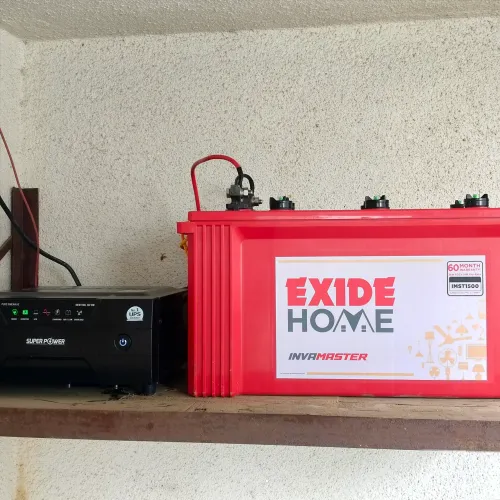
Short backup, no output, beeping, low-battery shutdown, overload trips, slow charging and failure during repeated power cuts point to different checks—not one diagnosis for an exide home invatubular backup problem. For short backup, record each appliance’s running load in watts and the exact time until low-voltage cut-off; counting fans or lights is not enough.
- No output: check whether the inverter display is active, mains has failed, the output MCB or fuse has tripped, and the connected socket is live.
- Repeated beeping: note the beep pattern and indicator lights. Beeping can signal low battery, overload, charging fault or an inverter alarm.
- Low-battery shutdown: switch off nonessential loads and check whether shutdown stops with a smaller load.
- Overload trip: remove refrigerators, pumps and other motor-driven appliances before retrying; their starting surge can exceed the inverter rating.
- Slow charging or repeated power-cut failure: record recharge time, mains stability and whether the battery reaches full charge.
| Symptom | Check now | What it suggests |
|---|---|---|
| Short backup | Watt load and cut-off time | Load, ageing, discharge or wiring issue |
| No output | Display, MCB or fuse, live socket | Mains, protection or inverter fault |
| Immediate alarm or shutdown | Reduce load once | Testing required if it repeats |
Reset the inverter once only when there is no smell, heat, smoke, spark or visible damage. A repeated alarm, immediate shutdown or failure after load reduction requires testing, not repeated resets.
How can you separate a battery fault from a load, inverter or wiring fault?
A Hinjewadi search for an Exide battery shop and Home InvaTubular backup problems should begin with the load, not a battery replacement. List every connected appliance, record running watts, and mark refrigerators, pumps and other motor-driven equipment as starting-surge loads.
| Appliance group | Diagnostic point | Common consequence |
|---|---|---|
| Fans, LED lights, routers, televisions | Record their individual running watts | Lower, steadier load |
| Refrigerators and pumps | Record running watts and starting surge | Inverter overload or trip |
| All appliances together | Compare load with inverter watts and VA | One rating alone can mislead |
Check the inverter’s rated watts and VA. Motors can trip an inverter during startup even when running wattage appears acceptable.
Nominal watt-hours = battery volts × Ah. Approximate AC backup hours = nominal watt-hours × usable discharge fraction × inverter efficiency ÷ load watts.
A 12-volt, 150-Ah battery stores 1,800 Wh nominally; at 50% usable discharge and 80% efficiency, it provides about 720 Wh, or roughly two hours at 360 W before ageing and high-load effects. C10 capacity also falls when discharge is faster than the rated 10-hour rate.
In a 24-volt system, two matching 12-volt batteries in series retain the Ah rating but double nominal energy. One weak battery can limit the string.
| Test | What it separates | Action |
|---|---|---|
| Known-light load versus normal load | Load fault | Compare backup time |
| Battery voltage under load | Battery weakness | Technician test |
| Inverter output and cable voltage drop | Inverter or wiring fault | Repair after measurement |
Record cable length and size, charging voltage, resting voltage and cut-off time for diagnosis.
What should you inspect when charging is slow or the battery stays warm?
A slow charge or warm battery in an exide home invatubular backup problem needs a measured inspection, not repeated resets. Stop and arrange service for acid smell, smoke, sparks, severe heating, bulging, cracked casing, leakage, sulphation deposits or heavily corroded terminals.
1. Isolate mains and connected loads only when there is no smell, heat, smoke, spark or visible damage. Confirm battery polarity, tighten terminals, and inspect cable thickness and excessive cable length.
A 1,200-watt AC load can draw more than 100 amps from a 12-volt battery after inverter losses; undersized cables can overheat, drop voltage and trigger low-voltage cut-off.
2. Check the fuse or MCB, inverter ventilation and installation area. Keep flames, smoking materials and sparks away from a flooded battery, because charging releases hydrogen and oxygen. Look for loose connections, melted insulation and corrosion.
3. For a flooded tubular battery, compare electrolyte with the MIN and MAX marks. Add distilled or deionised water only; never add acid for routine topping-up or fill above MAX.
4. If the battery never reaches full charge, stays warm, loses water quickly or recharges unusually slowly, record charging voltage and current. Check mains stability, inverter charging settings and battery condition; a no-load voltage alone cannot prove health.
Do not open, short or casually handle a damaged lead-acid battery. Stop using it and arrange professional service.
Is the problem installation-related, battery ageing or the wrong replacement choice?
Separate a new-installation fault from ageing before blaming the battery. An exide home invatubular backup problem appearing immediately after installation points to wiring, settings, charging or load sizing; deterioration follows repeated deep discharge, chronic undercharging, overloading, heat or months without maintenance charging.
At 80% depth of discharge, using 80% of rated capacity leaves little reserve for the next outage and stresses the battery. A 1,200-cycle claim is not a promise of 1,200 household power cuts.
Home Invatubular | Home Invamaster Use pattern | Occasional, light backup | Frequent outages and heavier cycling Expected load | Fans, lights, router, television | Larger or more demanding backup loads Budget | Easier to justify | Higher cost needs regular use to make sense Maintenance effort | Follow charging and water checks | Premium choice still needs correct maintenance
Home Invamaster is harder to justify for occasional light backup; frequent outages and deeper cycling justify investigating its higher specification. Check the manufacturing date or serial record, not the purchase date alone.
Size the battery and inverter together. Match Ah to the inverter’s charging system, check both VA and watts, and allow for refrigerator or pump starting surge. In a series bank, use batteries of the same model, age and condition; one weak unit limits both. Do not replace a battery by appearance alone.
A load test and charging check should decide whether the fault is installation, ageing or a wrong replacement.
What should you take to an Exide battery shop in Hinjewadi for a proper diagnosis?
Reduce the load and request testing if backup is short, alarms recur, charging is slow, or the inverter works only with a small load. Stop using it immediately for smoke, sparks, acid smell, leakage, swelling, severe heating, or a cracked casing; disconnect mains and the load only when safe.
- If the battery passes testing, investigate the inverter, charging circuit, cable size, cable length, connections, or load.
- If testing confirms an exhausted battery, replace it rather than repeatedly resetting or repairing it.
- If the casing is damaged or leakage is present, replacement is safer than repair.
Take the battery model, serial number or manufacturing date, purchase date, warranty card or invoice, inverter model, Ah rating, appliance list, measured watts, backup duration until low-voltage cut-off, water level, cable length and size, and the exact indicator or beep pattern.
Include whether the load contains a refrigerator, pump, or other motor that needs starting surge.
Ask the technician to measure charging voltage and current, terminal voltage at rest, voltage under a known load, electrolyte condition or specific gravity where appropriate, and battery-to-inverter connections. A no-load voltage reading alone does not prove battery health, and universal pass/fail figures can mislead.
For home inverter battery support hinjewadi, ask whether New Lucky Battery And Inverter provides delivery, installation, on-site diagnosis, old-battery collection, warranty assistance, and service for residential, commercial, or industrial systems. An exide battery shop hinjewadi visit should produce measured findings, not an automatic battery sale.
Related products
 | Inverter Batteries Premium Range - The Ultimate Inverter Battery Tough Condition - Tough Battery with Thicker Plates Long Life - 1200 Cycles @ 80% DOD More Electrolyte... View product → |
 | Inverter Batteries Standard Range Tubular Plate Design Suitable for Deep Discharge 1000 Cycles @ 80% DOD View product → |
Frequently asked questions
Which Exide Home Invatubular backup symptoms need different checks?
Short backup, no output, beeping, low-battery shutdown, overload trips and slow charging indicate different fault paths. Record the load, runtime and exact inverter warning before testing.
How can you separate a battery fault from a load, inverter or wiring fault?
Measure the connected load in watts, inspect terminals and cables, test battery voltage at rest and under load, and check whether the inverter charges correctly with the load disconnected.
What should you inspect when charging is slow or the battery stays warm?
Check charger settings, charging current, terminal tightness, ventilation, electrolyte level and signs of swelling or leakage. Stop use if the battery becomes unusually hot or damaged.
Is the problem installation-related, battery ageing or the wrong replacement choice?
Compare the battery capacity with the actual load and outage pattern, then review installation quality and battery age. A correctly sized replacement will not fix undersized cables, excessive load or inverter faults.
What should you take to an Exide battery shop in Hinjewadi for diagnosis?
Take the battery model and serial details, purchase date, warranty documents, inverter model, appliance list, runtime readings, error codes and clear photos of the installation.
Keywords