An Exide Eezy battery is a conventional 12-volt starting battery, but the word Eezy does not identify one universal size or fitment. You will be able to understand its starting and charging cycle, match the correct specification to your car, recognise battery or charging faults, and ask a dealer for a safe, documented installation.
Key takeaways
- Match the battery’s size, terminal layout and polarity to your car.
- A clicking starter does not prove the battery is the only fault.
- Replace Eezy when testing shows low capacity or repeated starting failure.
- Ask the dealer to record the battery details and installation date.
What an Exide Eezy Battery Does When You Start the Car
A 12-volt Exide Eezy battery delivers a short, high-current burst to turn the starter motor. That burst comes from chemical energy stored in lead plates and electrolyte inside the battery, which produces electrical current when you turn the key or press the start button.
The starter uses this current to crank the engine until combustion begins. Headlights, the fuel pump, engine computer and ignition system also draw power during this moment, so a weak battery can cause slow cranking or a clicking sound instead of a start.
After the engine runs, the alternator recharges the battery. It converts the engine’s mechanical rotation into electrical power, supplying the car’s systems and replacing charge used during starting. The alternator cannot repair a failed battery, and a charging fault can leave a good battery repeatedly flat.
Exide Eezy everyday cars usually means conventional petrol or diesel vehicles such as:
- Small hatchbacks
- Compact sedans
- Family SUVs
- Taxis and other regularly driven cars
Eezy is a starting, lighting and ignition battery, not an inverter battery or deep-cycle battery for running appliances for hours. The exact variant still depends on the car’s original specification, including its ampere-hour capacity, starting-current requirement and physical fit.
A conventional Eezy battery is unsuitable when the vehicle requires an AGM or EFB battery for start-stop operation.
How to Match Eezy Size and Polarity to Your Car
“Eezy” is a range name, not a single battery size. Match the battery to your car’s exact model, engine, year and equipment; the wrong capacity or terminal position can leave cables strained, the battery unsecured or the car unable to start.
Check these details before buying:
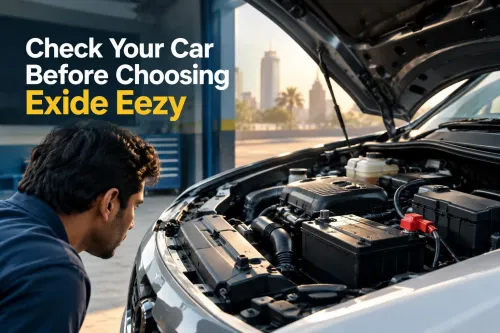
- Owner’s manual and old battery label: confirm the required ampere-hour (Ah) rating, cold-cranking or starting-current rating, voltage and battery group or size code.
- Case dimensions: measure length, width and height, including any raised lid or vent features. A battery that is too tall can touch the bonnet.
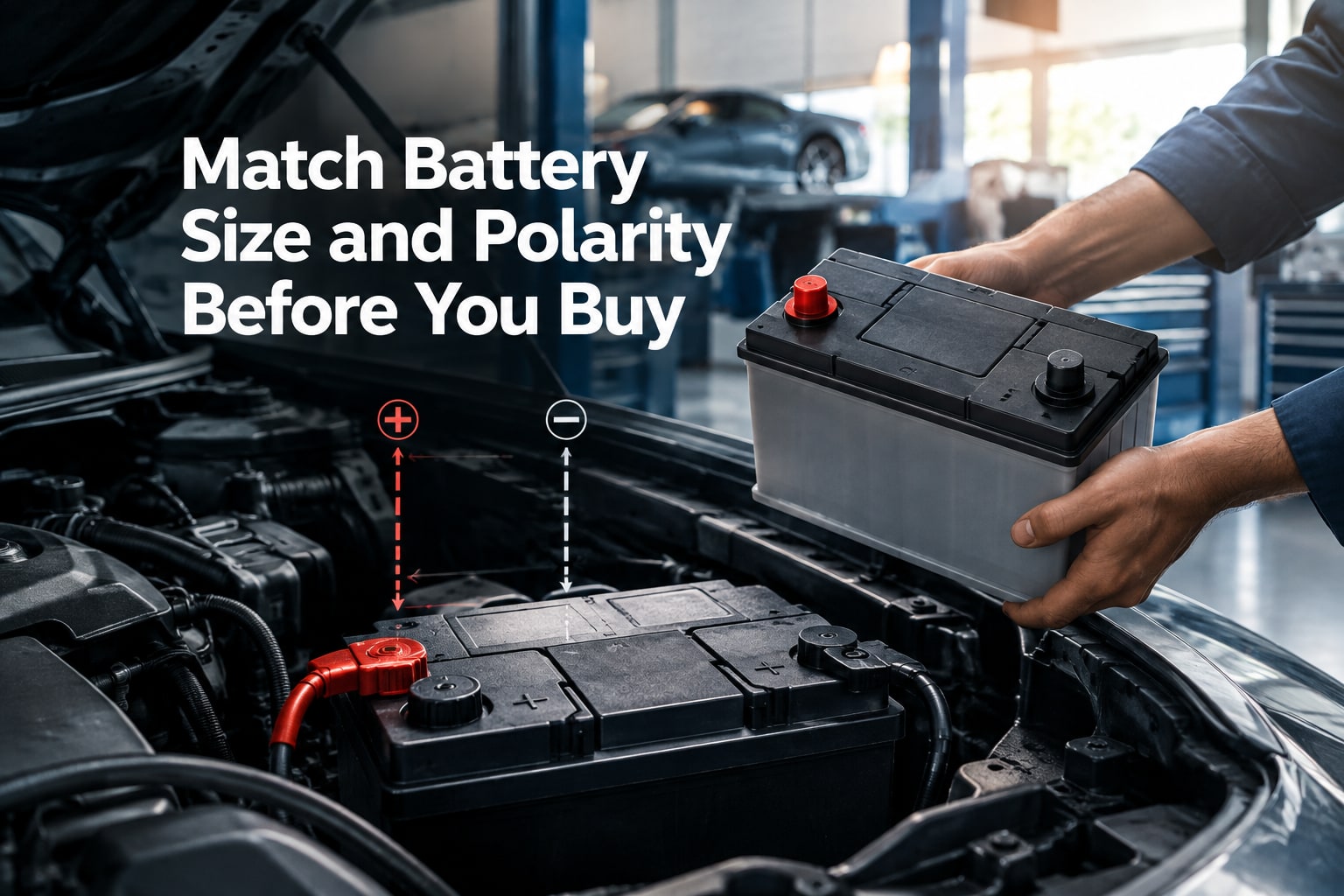
- Terminal polarity: check whether the positive terminal is on the left or right when the terminals face you. Match the old layout exactly.
- Hold-down arrangement: identify the base clamp, upper bracket or retaining bar. The battery must sit firmly without improvised packing.
- Vehicle technology: check whether the car uses start-stop, an EFB or AGM battery, or an energy-management system. A conventional Eezy replacement is not suitable when the manufacturer specifies those technologies.
| Information | Where to check | Why it matters |
|---|---|---|
| Ah and starting-current rating | Manual and old label | Prevents insufficient starting performance |
| Size and group code | Old label and measurement | Ensures physical fit |
| Polarity and terminals | Existing battery | Prevents reversed or stretched connections |
| Hold-down type | Battery tray | Keeps the battery secure |
Use the exact vehicle details for exide eezy car applications, not a generic online size chart. Ask for a fitment check and pre-installation test before accepting the battery.
When Eezy Makes Sense—and When Another Battery Is Needed
Exide Eezy suits everyday cars when the vehicle uses a conventional 12-volt starting, lighting and ignition system. That includes many petrol or diesel hatchbacks, sedans, compact SUVs and taxis, but the correct variant still depends on engine, trim and model year.
Compare the required ampere-hour capacity, starting-current rating, case dimensions, polarity and hold-down—not just the name.
| Option | What to compare | When it applies |
|---|---|---|
| Exide Eezy | Required Ah, starting current, dimensions and terminal layout | A conventional car needing a standard SLI replacement |
| Exide Mileage | Vehicle fitment, specification and current warranty terms | When its documented rating and fitment match the car better than Eezy |
| Exide EPIQ | Required performance, physical fit and vehicle compatibility | When the vehicle specification or usage calls for that model’s documented capability |
Do not choose Mileage or EPIQ solely because one sounds more powerful. A physically larger battery can have the wrong terminal position, clamp arrangement or charging requirement.
Eezy is the wrong specification when:
- Your car has start-stop and requires an EFB or AGM battery. A conventional Eezy battery can reduce cycling performance and trigger start-stop or battery-management faults.
- The owner’s manual or original label specifies AGM, EFB, a different Ah rating or a higher starting-current requirement.
- You need to run lights, appliances or an inverter for hours. Eezy is an SLI starter battery, not a deep-cycle or inverter battery.
- The available variant fails the length, width, height, polarity or hold-down check.
Have the exact vehicle fitment confirmed before installation.
Battery Failure, Charging Faults and Replacement Timing
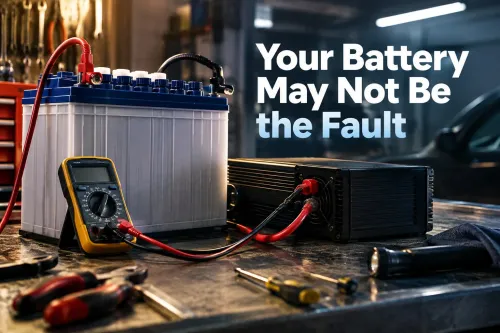
Do not replace an exide eezy vehicle battery until testing separates battery failure from a charging or wiring fault. A battery can show 12.6 volts after charging and still collapse during cranking; a healthy battery can show low voltage simply because the car has left it discharged.
- Switch off the car, let the battery rest for several hours, then measure open-circuit voltage. About 12.6–12.8 V indicates a charged 12-volt battery; below 12.2 V indicates significant discharge.
- Charge the battery fully, then perform a load or conductance test. A sharp voltage drop during the test, or a failed conductance result, points to battery replacement rather than a simple recharge.
- Inspect both terminals and the negative earth strap. White or green deposits, a loose clamp, a cracked cable or rust beneath the earth connection can restrict current and mimic a dead battery.
- Measure charging voltage at the battery with the engine running. Roughly 13.8–14.7 V suits many conventional systems; low voltage suggests an alternator, belt, regulator or cable fault, while excessive voltage risks battery and electronic damage.
- Check parasitic drain after the vehicle enters sleep mode. A clamp meter or fuse-by-fuse test can identify lights, accessories or modules that keep drawing current after locking.
Replace the battery when it fails a test after full charging and the connections and charging system pass. If it repeatedly goes flat while those tests pass, find the drain first; a new Exide Eezy vehicle battery will not cure it.
What to Ask an Exide Battery Dealer Before Installation
Before installation, verify the exact battery, its condition, the paperwork and the tests—not just whether an Eezy box is on the shelf. If you found an exide battery dealer hinjewadi eezy listing, confirm local stock and warranty handling directly with that outlet.
1. Ask for a vehicle-specific fitment check using the owner’s manual and old battery label. Confirm the Eezy variant’s Ah capacity, starting-current rating, case length, width, height, terminal polarity and hold-down arrangement. Do not substitute it for an AGM or EFB battery in a start-stop car.
2. Confirm that the battery is fresh stock. Ask the dealer to show you the manufacturing date or date code and explain how long the battery has been stored.
3. Request diagnosis before replacement: visual inspection, open-circuit voltage, a load or conductance test and alternator charging-voltage testing. A charged battery can still fail under load, while a healthy battery can test weak after deep discharge.
4. Require correct terminal orientation, secure hold-down fitting and a charging-system test after installation. Record the battery model, serial or date code, installation date, vehicle registration or VIN and dealer invoice.
5. Read the current warranty document before paying. Confirm its duration, exclusions, free-replacement terms, pro-rata period and the process for a stranded vehicle or warranty inspection.
Whether you use New Lucky Battery And Inverter or another exide for battery dealer, keep these records with the car so support does not depend on memory.
Related product
 | AUTOMOTIVE BATTERIES Presenting Exide EEZY. The latest entrant from Exide with advanced features and cutting-edge design. View product → |
Frequently asked questions
What does an Exide Eezy battery do when you start the car?
It supplies a short, high-current burst to the starter motor, which cranks the engine. The alternator then recharges the battery after the engine starts.
How do I match an Exide Eezy battery to my car?
Check the existing battery’s physical dimensions, terminal positions, polarity, capacity, starting rating and hold-down arrangement. Confirm the replacement against the vehicle handbook or fitment catalogue.
When is an Exide Eezy battery the wrong choice?
Choose another battery when your vehicle requires a different case size, higher starting capacity, an enhanced flooded battery, an AGM battery or a battery designed for start-stop use.
How can I tell whether battery failure comes from charging faults?
Have the battery’s resting voltage, cranking performance and alternator charging voltage tested. A weak alternator, loose connection or parasitic drain can cause repeated battery failure.
What should I ask an Exide battery dealer before installation?
Ask the dealer to confirm fitment, polarity, warranty terms, manufacturing or batch details, the old-battery exchange process and whether the charging system will be tested after installation.
Keywords