Exide Mileage can suit many company cars, taxis, delivery vehicles and light commercial fleets, but the vehicle’s battery specification and daily duty cycle must match the selected model. By the end, you will be able to identify suitable business uses, reject unsuitable fitments, compare ownership costs and plan battery service around fleet uptime.
Key takeaways
- Match battery group size, voltage, capacity and terminal layout to the vehicle.
- Use Exide Mileage for standard starting needs, not every commercial duty cycle.
- Compare warranty, fitment, replacement time and total fleet downtime cost.
- Record battery age, starting symptoms and replacement dates across the fleet.
Which business vehicles are suitable for Exide Mileage?
An Exide Mileage starting battery suits company cars, rental cars, taxis, delivery cars, small vans, field-service vehicles and other fleet vehicles when the manufacturer’s battery specification matches the selected model.
An automotive battery dealer assessing Exide Mileage business use should separate engine starting from sustained electrical supply: Mileage handles starting and short-duration loads, not hours of engine-off power.
| Vehicle pattern | Suitable use | Main risk |
|---|---|---|
| Company or rental car | Normal daily driving and occasional parking | Standby drain during long storage |
| Taxi or delivery car | Repeated starts and urban routes | Short trips and idling undercharge the battery |
| Field-service van | Starting with GPS, tracker or radio loads | Added accessories increase electrical demand |
| Mobile office or refrigeration van | Only with an engineered auxiliary system | Engine-off loads can exhaust a starting battery |
Daily kilometres matter less than journey length, starts per shift and idle time. Frequent short trips and long idling can leave a battery chronically undercharged; fitting a larger battery will not repair alternator faults or an unsuitable duty cycle. GPS trackers, dash cameras, radios and additional lighting add demand.
- Check the vehicle’s specified voltage, ampere-hour rating, cold-cranking-ampere requirement, dimensions, terminal layout and hold-down before choosing among Exide Mileage business vehicles.
- Use a separately engineered auxiliary or deep-cycle system for powered lifts, refrigeration, warning equipment, two-way radios or many hours of engine-off use.
- Charge a vehicle parked for weeks with periodic charging or an approved maintenance charger; occasional engine running may not restore the battery.
How do you match Exide Mileage to the vehicle before installation?
Two batteries can sit securely in the same tray and still be electrically unsuitable. Exide Mileage is appropriate for business vehicles only when the selected model matches the vehicle maker’s specification, not simply because the case appears to fit.
1. Read the manufacturer battery code in the owner’s manual, service record or existing battery label. Treat that code as the starting reference, not the Exide Mileage name alone.
2. Confirm system voltage, such as 12 volts, then match the ampere-hour rating, cold-cranking-ampere requirement and reserve-capacity requirement. A lower CCA can cause hard starting, while inadequate reserve capacity leaves the vehicle vulnerable during extended electrical use.
3. Measure case length, width and height. Check that the terminals do not foul the bonnet, cables or nearby components.
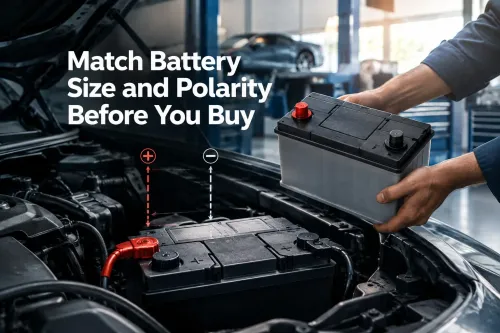
4. Match terminal type, terminal layout and polarity. Reversed polarity can damage electronic modules, and the wrong terminal position can prevent safe cable routing.
5. Match the hold-down arrangement and confirm that the charging system is compatible with the battery technology. A vehicle designed for EFB or AGM, especially one with start-stop or regenerative braking, is not automatically suitable for a conventional flooded battery.
6. Reject the fitment if CCA, reserve capacity, dimensions, polarity, mounting or charging requirements differ from the specification, even when the battery starts the engine during a quick test.
Record the exact model, serial or batch information, vehicle registration, installation date and test result. Obtain the model-specific warranty terms in writing; a Mileage warranty period is not a guaranteed service life.
When does a commercial vehicle need a different battery setup?
An Exide Mileage battery fits Exide Mileage commercial applications when the vehicle needs conventional starting power and short-duration electrical support, and its manufacturer-approved specification matches the selected model.
Company cars, taxis, rental cars, delivery cars, small vans and field-service vehicles can qualify; repeated short trips and long idling still require charging-system checks because a larger battery will not fix chronic undercharging.
Check these conditions before treating an Exide Mileage battery as the correct setup:
- Use a conventional flooded lead-acid model only when the vehicle is designed for that battery type.
- Choose EFB or AGM when the vehicle’s specification calls for it because of start-stop operation, regenerative braking or high accessory demand. Do not replace either with a standard flooded battery.
- Require the manufacturer-approved battery class for heavy-duty trucks, buses, tractors and construction equipment. Choosing an automotive battery by brand alone can cause poor starting, mounting problems or premature failure.
- Do not use a Mileage battery alone for refrigeration units, powered lifts, warning equipment, two-way radios or mobile-office equipment that operates with the engine off.
Engine-off use lasting hours needs a separately engineered auxiliary or deep-cycle system, not a starting battery forced into repeated discharge. The design needs battery isolation, a suitable charging source, correctly sized cabling, fusing and ventilation. This boundary matters across Exide Mileage business vehicles: the battery starts the engine, while the auxiliary system supplies sustained loads.
What should a fleet compare before buying through a dealer?
Compare the battery’s cost per available vehicle day, not its invoice price. A warranty period is not a promised service life: life depends on the exact model, installation, charging system, duty cycle and exclusions.
| Option | What to compare | Why it affects fleet cost |
|---|---|---|
| Battery life | Expected service life, without treating warranty duration as a guarantee | Planned replacement is cheaper than an unplanned roadside failure |
| Starting performance | Required CCA and reserve capacity against the vehicle specification | Inadequate starting power causes no-starts, especially after repeated short trips |
| Protection and upkeep | Spill resistance, secure mounting, terminal condition and maintenance needs | Leaks, vibration, corrosion and loose connections shorten service life |
| Warranty evidence | Model-specific terms, exclusions, invoice, installation date, serial or batch number and test result | Missing records can delay or defeat a valid claim |
| Downtime | Roadside call-out, technician hours, vehicle unavailability and replacement time | A cheaper battery costs more when a delivery vehicle is stranded |
| Total cost | Purchase, installation, planned replacement and failure-related costs per vehicle | Shows the real cost of ownership |
Ask the dealer to confirm the battery code, polarity, dimensions, hold-down, charging compatibility and fitment before installation. An automotive battery dealer Pune fleet service adds value when it provides on-site testing, mobile replacement, installation, removed-battery collection and model-specific warranty records.
New Lucky Battery And Inverter is one local option for Hinjewadi and Pune fleets needing those services. Choose by correct specification and uptime, not the Exide name alone. For a search comparing automotive battery dealer Exide Mileage business use, insist on this evidence before ordering.
Related product
 | AUTOMOTIVE BATTERIES Robust design - to take care of stringent application requirements Special side vented cover design - excellent spill-resistant characteristics... View product → |
How can commercial fleets prevent battery-related downtime?
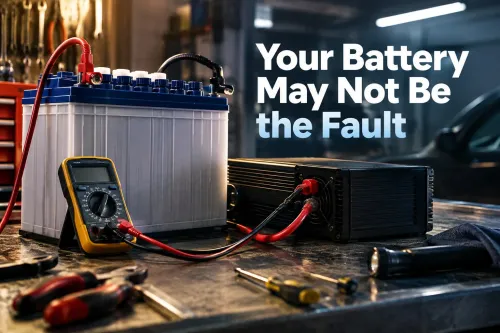
At every battery replacement, test both the battery and charging system before fitting the new unit. A failed battery may be the symptom of alternator undercharging, excessive key-off drain, a poor earth connection, a slipping belt, or a starter motor drawing excessive current.
- Measure charging voltage at the battery terminals with the engine running and compare it with the vehicle maker’s specification.
- Inspect terminals for corrosion, confirm correct polarity, and check that the battery is secure.
- Examine the tray, clamp or hold-down hardware, earth cables and drive belt for damage, looseness or slipping.
- Record whether trackers, alarms, dash cameras, radios or other accessories operate with the engine off.
- Test key-off current and starter draw when the vehicle has repeated battery failures.
For Exide Mileage commercial applications, keep a record for each vehicle: registration number, battery model, serial or batch information, installation date, test result and warranty document. An automotive battery dealer in Pune can attach these records to the installation rather than treating every failure as normal battery ageing.
A jump start restores engine operation but does not fully recharge a discharged lead-acid battery. After repeated jump starts, charge the battery with a suitable charger and test alternator output and parasitic drain.
Vehicles parked for weeks need periodic charging or an approved maintenance charger; occasional engine running may not replace standby losses. Schedule replacement during planned fleet downtime, then send the used battery through an authorised collection or recycling channel under India’s Battery Waste Management Rules, 2022.
Frequently asked questions
Which business vehicles are suitable for Exide Mileage?
Company cars, rental cars, taxis, delivery cars, small vans and field-service vehicles are suitable when their manufacturer specification matches the selected Exide Mileage model.
How do you match Exide Mileage to a vehicle before installation?
Check the vehicle manual or existing battery for voltage, Ah capacity, CCA, group size, dimensions, terminal polarity and hold-down design before installation.
When does a commercial vehicle need a different battery setup?
Choose a different setup when the vehicle has heavy accessory loads, frequent stop-start use, long parked periods, dual batteries, high starting demand or a manufacturer-specified AGM, EFB or deep-cycle battery.
What should a fleet compare before buying through a dealer?
Compare the exact model specification, warranty terms, stock availability, installation time, testing process, delivery coverage and the cost of vehicle downtime.
How can commercial fleets prevent battery-related downtime?
Log battery installation dates, inspect terminals, test starting performance during scheduled servicing and replace weak batteries before planned high-use periods.
Keywords